
The EU's Russia Strategy
Big Talk; Hedging Bets

I spent a good portion of my life in Europe. I was born in Ukraine when it was still part of the USSR; my family and I spent several months living in Italy while we awaited our authorization to immigrate to the United States; I was stationed in Germany for three years when I served in the US Army and spent another year in Kosovo, deployed there in 2007.
I spent several summers with relatives in France when I was a teenager and months in the Netherlands as a college student.
And when I worked for the US government, I traveled to different parts of Europe as part of my job. A lot.
I love Europe. I love the culture, the architecture, the people, and the history. The beauty I have seen is unmatched anywhere, and Europe will always be in my soul, even as a US citizen.
So it breaks my heart to watch the immoral cowardice with which the EU is hedging its bets on Russia, even as it talks big about supporting Ukraine, stopping Russia’s aggression and war crimes, and holding Russia accountable for its malevolence.
Tough talk
The EU is currently discussing its 21st tranche of sanctions against Russia since Moscow’s full-scale invasion of Ukraine. One would think that an agreement among all EU members would be easier now that the corrupt Kremlin puppet Viktor Orbán and his lapdog Péter Szijjártó, who this year admitted that he called Russian foreign minister Sergey Lavrov before and after EU meetings, essentially spying for the Russians, are gone.
But there are other EU member states making consensus difficult. Because of money.
Kaja Kallas, the EU’s Foreign Policy Chief, yesterday confirmed that the 21st sanctions package will have more than 250 designations, noting that this will be the biggest round of individual sanctions since Russia’s full-scale invasion, targeting the financial backbone of Russia's war machine.
Yes, there’s a lot of tough talk there, and to her credit, Kallas also addressed normalization, about which I wrote a few weeks ago, instead of just ignoring the fact that Russia’s aggression is gradually becoming the status quo, as media outlets publish op-eds by Russian oligarchs, sports organizations once again accept Russian athletes competing under the Russian flag, and cultural organizations allow Russian soft-power participants.
The International Olympic Committee's decision to invite Russian athletes back to international competitions is blind to reality. Ministers strongly condemn such decision, as it coincides with Russia killing record number of Ukrainian civilians. So, it looks like International Olympic Committee is rewarding such attacks. The Commission is ending the funding to Venice Biennale. Culture and support must not become vehicles of whitewashing aggression.
The EU and the UK together issued joint designations a few days ago, targeting Russia’s criminal cyber operations. The UK sanctions package includes 23 individuals and one entity carrying out malign attacks and disinformation in Europe and the UK.
The UK sanctioned several GRU senior leaders, including Vyacheslav Stafeyev, Ivan Senin, and Ivan Kasyanenko for directing GRU cyber and hybrid threat operations.
The UK noted that GRU Unit 29155’s (yes, the same one linked to Havana Syndrome and other global assassinations and hybrid operations) cyber division worked with criminals, including the now-designated OOO IMPULS to recruit hackers and cyber specialists from universities and academies across Russia.
Russia also continues its disinformation operations, so 10 leaders of Rybar LLC, including directors, senior management, and content designers have been sanctioned. Rybar LLC is a media company linked to and funded by the Russian state and is responsible for spreading false narratives about Ukraine and interfering in elections in Moldova and Armenia.
In addition, the UK listed several individuals behind Lumma Stealer which cybercriminals use to collect sensitive information from compromised devices. Russia has used Lumma Stealer’s stolen credentials to conduct cyber espionage operations against global targets to support the Kremlin’s objectives, and the UK’s National Crime Agency (NCA) says that within the last six months, there have been at least 2,100 Lumma Stealer victims in the UK.
Very few of the individuals listed by the UK this week are sanctioned by OFAC. The US Treasury designated Yuliya Pankratova and Denis Degtyarenko in July 2024 for being members of the Russian hacktivist group Cyber Army of Russia Reborn (CARR). According to the Treasury press release, the duo were sanctioned pursuant to EO 13694 for their roles in cyber operations against US critical infrastructure. The duo is the group’s leader and a primary hacker, respectively. But that’s it.
In addition, the UK and the EU officially attributed the failed December attack on Poland’s energy grid to Russia’s FSB Centre 16. Had it been successful, the chaos and suffering would have been untold in the dead of winter!
Hedging bets
However this tough talk is accompanied by actions which don’t match the words. Europe continues to be dependent on Russian energy, sending billions of dollars to fund Putin’s continued bloodshed and savagery.
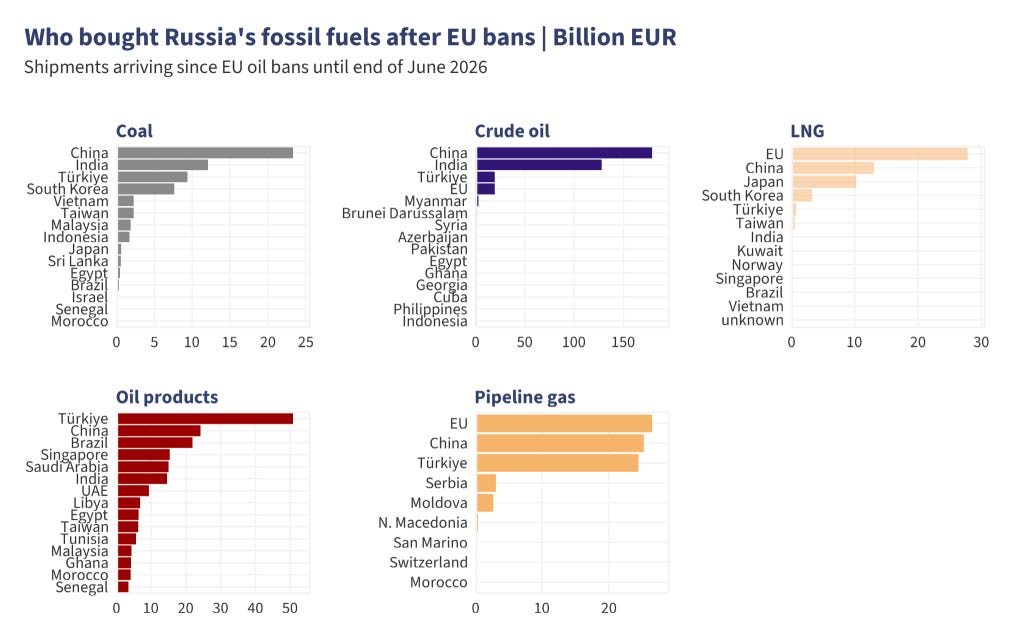
The Financial Times this week confirmed that the EU has bought more Russian liquefied natural gas (LNG) than ever during the first half of this year.
EU purchases from Yamal LNG, which Russia’s privately owned Novatek controls, reached a record 9.89mn tonnes in the first six months of the year — 18 per cent more than in the same period last year, according to data from analytics company Kpler.
The figures underline the crucial role Europe still plays in keeping Russia’s flagship energy facility running as Moscow’s war against Ukraine drags through its fifth year.
Sure, the EU is phasing out Russian energy purchases, but in the meantime, let’s gobble up as much Russian product as possible? Come on!
Other issues have arisen, according to the Kyiv Independent.
The EU's $44.10 price cap on Russian oil could expire, unless quickly renewed because of US President Donald Trump’s continued military entanglement in Iran, which has pushed oil prices higher. Apparently that inconvenience is worth the price of mass murder to some EU members.
Greece is cranky because keeping the oil price cap steady until the volatility in the energy markets calms down will mean less profits for Athens because ships will no longer fly under a Greek flag, but rather will choose to register vessels that violate the restriction in countries outside the EU.
Greek shipping companies are also making a ton of money—at least $3.8 billion during the past three years, according to the Financial Times—shipping Russian energy. The FT calculates that Dynacom Tankers, founded by Greek shipping billionaire George Prokopiou, made at least $915 million in revenues shipping Russian crude since July 2023.
Portugal opposes proposals to limit imports of certain types of Russian fish, fearing it could spell the death of its fish finger industry. So mass murders, rapes, torture, targeting of civilians, hospitals, and schools, and the kidnapping of thousands of Ukrainian children is perfectly fine with Portugal as long as its fish stick profits are intact.
Bulgaria has demanded and achieved the removal of Russian Orthodox Church head Patriarch Kirill ((aka Vladimir Gundyayev—confirmed Russian KGB thug) from the EU’s sanctions list, claiming that the Russian Orthodox Church has contributed to Bulgaria’s liberation from Ottoman slavery. Never mind that the Russian Orthodox Church has actively declared Russia’s Ukraine invasion a holy war that must be won.
Never mind that the Kremlin uses its close ties with Kirill and the Russian Orthodox Church as a lever of soft power against its neighbors, promoting Moscow’s agenda and the idea of Russky mir, or Russian World, to promote Russian foreign policy—”the perverse intersection of the interests of the Russian state and the Russian Orthodox Church,” according to the Carnegie Council's US Global Engagement Initiative (USGE). Is this what Bulgaria wants after shedding its Soviet ties and joining the EU in 2007?
Meanwhile, the Economist a few days ago published an op-ed by sanctioned Russian oligarch Andrey Melnichenko, who is calling for an alternative vision for Russia—an integration with the West—claiming complete economic collapse would threaten global stability.
Sound familiar? A Russian oligarch—one of the country’s richest men—is calling for integration (read: more bucks for Moscow, so it can engage in the same aggression in which it has been engaged since the fall of the USSR, aided by trillions of dollars in aid from the international community).
Let’s get something straight, despite the fawning conversation about the oligarch in this video, the only one responsible for Russia’s economic woes is Putin. Period. Russia’s isolation is wholly Russia’s fault—not anyone else’s. It doesn’t matter how charming Melnichenko pretends to be. As UK-based geopolitical analyst Alexander Kokcharov yesterday correctly stated on X (formerly Twitter), that reality cannot be ignored. Melnichenko talks as if it’s the West’s fault that Russia is being isolated, and not the Kremlin’s for engaging in acts of genocide, war crimes, and unprovoked aggression.
Here are the three major flaws in this "geopolitical realism" approach, according to Kokcharov:
The recent essay in the Economist ignores Ukrainian agency: It treats Ukraine as a passive chessboard for a superpower showdown, entirely ignoring that Ukrainians are sovereign actors who have repeatedly chosen their own political future through elections, mobilisation, and fierce resistance.
The essay recycles Kremlin narratives: It subtly shifts the blame away from Kremlin's ongoing aggression abroad and repression at home and onto Western policies, implicitly arguing that European security depends on accommodating Russia's revisionist demands.
The essay is based on analytical asymmetry: It treats Russia’s violent behaviour as an unchangeable, fixed constraint while demanding that the choices of Ukraine and the West be the variables that must bend. Ultimately, this perspective doesn't analyse the crisis
It normalises it by ignoring the root causes, Kokcharov correctly states. “I honestly have no idea why The Economist chose to provide a platform for Melnichenko’s - or the Kremlin’s - voice.”
Why, indeed?
The next EU sanctions package
The EU needs to stop hedging its bets and pretending Russia is somehow going to rehab itself into a democracy, which will rejoin the international global order. It will not. We already have seen what happens when trillions of dollars are poured into this corrupt aggressor.
Sanctions are one thing, but as I’ve often said, enforcement is absolutely crucial!
Stop giving companies and entities that enable Russian sanctions evasion a pass.
Stop leaving gaping loopholes that facilitate the continued flood of western funds into Putin’s pockets.
Stop pretending that Russia is somehow crucial to the economic world order. It’s not. it steals grain from Ukraine and ships it for profit. Its role as a major provider of energy is facilitated by countries will willing to purchase its oil and natural gas, exploiting the cheap prices and ignoring Moscow’s bloodshed.
Stop worrying about nuclear escalation. Moscow, and particularly drunken thug Dmitry Medvedev, have been threatening to use nuclear weapons against the West for years. No one but the biggest cowards takes them seriously any longer.
Stop allowing Russians into the EU, stop issuing them visas, enabling them to visit or even move to Europe. These people are not tourists. They are aggressive, sometimes violent thugs, sometimes spies, and sometimes outright assassins, according to research by Roman Sheremeta published yesterday.
They have a history of attacking individuals in Europe (remember Litvinenko, the Skripals, Kuzminov, and others).
Stop pretending they will change and start enforcing sanctions and restrictive measures.