
Spain and the Moroccan Invasion
Making an assessment

I thought about writing about the new version of the bipartisan Sanctioning Russia Act this week. The long-delayed legislation, which would target Russia’s energy profits, impose sanctions on Russian officials, and authorize 100 percent tariffs on the five largest importers of Russian crude oil or gas and the five top countries that help Moscow evade US sanctions, may be stymied once again.
The legislation advanced for procedural votes in the Senate this week. However…
President Trump threw a wrench in the works with his demand that Iran sanctions be included in the legislation.
Some policymakers oppose the tariff provisions, especially after the Supreme Court in February struck down the tariffs Trump imposed last year, which highlights the Administration’s need to somehow re-institute these tariffs.
Some lawmakers say they would prefer to wait to pass Russia sanctions until Democrats have more power, expecting a Democrat sweep in this fall’s midterm elections.
The sanctions bill would also allow the president to waive the Russia sanctions for unspecified “national security reasons,” which once again gives the White House the authority to ignore the sanctions—a risk given Trump’s continued waffling on the Russia/Ukraine war.
So instead of speculating about the bill, which could change a lot before and IF it’s eventually signed into law, let’s talk about analysis.
Critical thinking, personal biases, and analysis
I woke up this morning to the following, fantastical claim in my news feed:
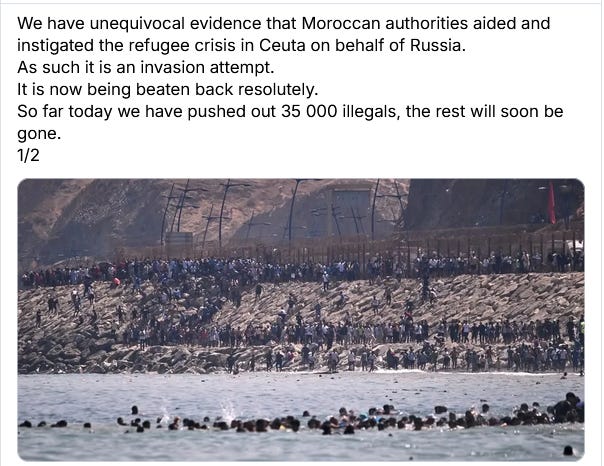
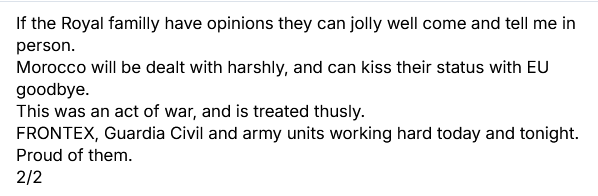
I had a sneaking suspicion the person was angling for clicks and had no clue what they were talking about, but I figured I’d take a quick look. I recognize cognitive biases in myself, and this instinct to believe any kind of negative claim about Russia.
A few claims here:
Morocco was acting on behalf of Russia.
There’s “unequivocal evidence” to support this claim.
The EU will somehow scrap its relationship with Morocco.
This was an “act of war.”
The most interesting claim to me was the “unequivocal evidence,” which is something that very few professional analysts will assert.
What evidence?
Who is the source?
What is the source’s record of credibility? Has this source reported credibly in the past?
What is the claim that Morocco was acting on behalf of Russia based on?
As of right now, we merely have an assertion from a rando, ostensibly located in Spain, but I’m not even sure about that; I’m basing that assessment from the tone of the post.
So I went digging.
What did I find?
Well, I did find evidence of Russian state-controlled propaganda and disinformation outlets opportunistically glomming onto the situation in Ceuta. I did not find any evidence that this loosening of border controls on the part of Morocco was in any way directed or encouraged by Russia.
Disinformation-research group the Cyfluence Research Center tracked hundreds of posts in the 24 hours after the crossings and found Russian state media and aligned accounts boosting narratives like “civilizational invasion” and “EU/Western collapse.” Normal Russian opportunistic exploitation. Nothing new there.
Although the events were still unfolding on the ground, they were instantly framed and weaponized, with several conspirative narratives quickly proliferated across platforms and key target audiences. The malign messaging was amplified by an existing infrastructure of influencers and online personas, seemingly in an attempt to target European and NATO cohesion.
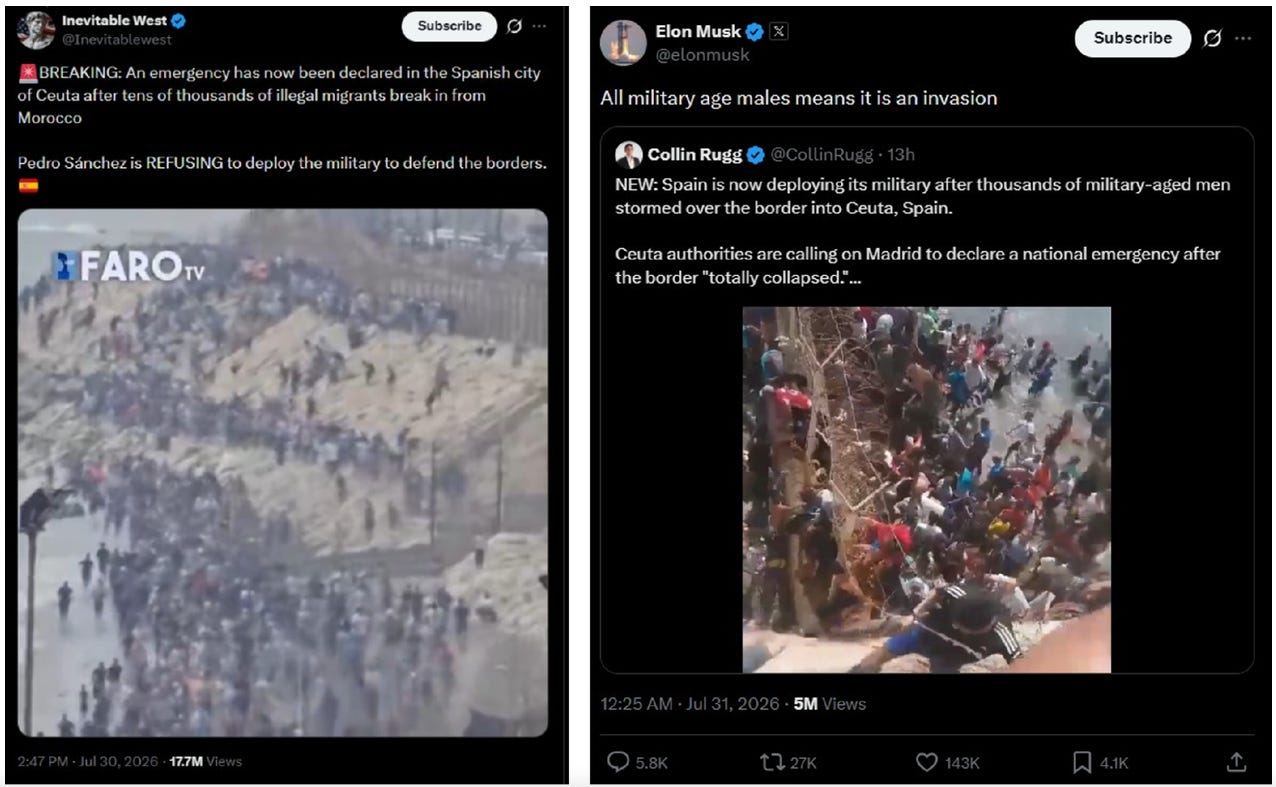
The exploitation of the situation in Ceuta appears to support Russian strategic objectives of weakening Western cohesion and control of strategic maritime routes – and particularly Spain's position as part of NATO’s southern flank.
Some online trolls and Russian disinformation outlets attribute the “operation” to "Spanish intelligence" and claim a Moroccan false flag. Neither claim has any basis in public record or official statement, according to Cyfluence.
Are Russian propagandists exploiting this? Of course they are! And Ukraine’s foreign ministry reportedly did accuse Russia of running a “propaganda campaign” around Ceuta, which is nothing new.
But is there any evidence that Morocco did this specifically on Russia’s behalf? No.
So unless the rando who posted this claim has insider knowledge of intelligence reporting or sources inside Spain’s security structures, the claim of “unequivocal evidence” is not at all credible.
Does Russian exploitation of the situation in Ceuta mean that Russia was somehow involved, directed, or otherwise orchestrated the “invasion?” No.
Opportunistic messaging is not equivalent to direct involvement. We have no evidence of that.
Act of War
The EU, of which Spain is a member, does not have a legal definition of the phrase “act of war.” Hybrid campaigns, according to the EU, are devised to remain below the threshold which could constitute or be perceived as an act of war.
Article 42 of the Treaty of the European Union states that “if a Member State is the victim of armed aggression on its territory, the other Member States shall have towards it an obligation of aid and assistance by all the means in their power, in accordance with Article 51 of the United Nations Charter.” So, EU law and policy documents rely on public international law, the UN Charter, and specific operational thresholds like armed aggression and hybrid threat levels.
Morocco’s historical actions
This is not the first time Morocco has opened its borders and ushered migrants into the EU. This is Rabat’s documented pattern of loosening border enforcement during diplomatic disputes with Spain.
For example, during a smaller dispute with Spain in 2021, after Madrid allowed the leader of the Polisario Front (The Popular Front for the Liberation of Saguia el-Hamra and Río de Oro—a Sahrawi nationalist liberation movement seeking to end the occupation of Western Sahara) Brahim Ghali to enter the country secretly for COVID-19 medical treatment, Morocco opened its borders and flooded Ceuta with roughly 8,000 migrants.
The timing is auspicious in this case as well. The massive surge of migrants came roughly 10 days after Spanish PM Sánchez visited Algeria (Morocco's rival) and discussed expanding gas ties.
Human smuggling networks are known to exploit Spain’s border crossing at Ceuta. I would assess that these criminal networks will attempt to further exploit the Spanish Supreme Court’s recent decision to end automatic/summary return of migrants intercepted swimming to Ceuta/Melilla, although CNN reports that the decision is much more narrow and focused than many have claimed.
On June 29, Spain’s Supreme Court issued a ruling stating that authorities cannot summarily deport migrants who arrive by sea without due process, because they did not cross the physical border infrastructure referenced in Spanish law.
The decision covers migrants intercepted while swimming into the exclaves of Ceuta and Melilla – also on the North African coast – who have often been subject to immediate removal to Morocco without any formal proceedings.
“It just means you cannot push them back at sea because there is no crossing of a formal border,” Gemma Pinyol-Jiménez, head of migration policies and diversity at Instrategies and an associate researcher at GRITIM–Pompeu Fabra University, told CNN.
“The idea is to facilitate the work of the police, but it doesn’t mean these people can stay in Ceuta.”
The lack of clarity on the Supreme Court’s decision provided a perfect open door for Russian actors and their associated assets to foment unrest and promote the messaging about weak border enforcement, invasion of Muslims, and the death of western civilization.
Morocco’s relationships
Morocco and Russia do have a formal “Strategic Partnership,” originally signed 2002 and deepened in 2016 by King Mohammed VI and Putin, marking its 10th anniversary in 2026. The leaders of the two countries meet regularly and have signed roughly 188 bilateral agreements covering trade, agriculture, fisheries, energy, and mining.
As a likely part of a broader Russian strategy to build relationships with US-aligned states in the Middle East/North Africa and demonstrate that Russia remains a viable partner even for countries embedded in Western security architecture, which Morocco is, Moscow has moved toward endorsing Morocco's autonomy plan for Western Sahara (rather than the referendum position it backed for decades).
After the collapse of the Russia-Arab Summit as a meaningful vehicle for regional engagement, Moscow redirected its focus toward select bilateral partnerships capable of preserving its legitimacy and access. Morocco emerged as the centerpiece of this strategy. Foreign Minister Nasser Bourita’s visit to Moscow and the establishment of the Russia Morocco Working Group marked a significant diplomatic achievement for the Kremlin, with Moscow reportedly offering expertise in energy and cybersecurity to deepen strategic cooperation. By signaling support for Morocco’s autonomy plan in Moroccan Sahara, Russia effectively neutralized a long standing pressure point that had constrained its relations with Rabat while simultaneously marginalizing the Polisario issue even within Algeria’s strategic calculus.
However, as I mentioned above, Morocco remains deeply entrenched in the western security architecture.
Morocco is a major US security partner—a “Major Non-NATO Ally,” which holds regular joint military exercises with US AFRICOM.
Morocco has close ties with France and the EU, including migration-cooperation and trade agreements, and it is the EU’s key North African migration-management partner.
Its recognition of Israel (2020 Abraham Accords) further embeds it in a US-aligned regional posture.
So the claim that “Morocco will be dealt with harshly, and can kiss their status with EU goodbye” seems spurious given all the information that directly and indirectly contradicts this individual’s claims.
Bottom Line
I recognize my own biases when it comes to Russia, especially given my former career and my background as a refugee from Ukraine during the Cold War. So I will be the first to acknowledge that blaming Russia is my reflexive instinct for any unrest in Europe.
In this case, however, as tempting as it may be to claim that Russia is responsible for all the ills in the world, the existing evidence points to opportunistic propaganda rather than direct involvement.
My best advice:
Examine your own biases before making claims.
Look at who is spreading the propaganda.
What sources are being cited? Remember, Russia’s cognitive warfare can skew your research.
Whom does the propaganda benefit?
What kind of language is used in claims?
What is the context? Do the claims appear credible, given everything else you know about the situation?
Do not surrender to your first instinct - to blame Russia (no matter how tempting) and spread disinformation. You are not doing the information space any favors.
One of my mentors once advised me that "unequivocal evidence" was as rare as hen's teeth. All evidence is equivocal: from how it's collected to how it's analyzed to how it's presented, at each step there are opportunities for uncertainties to accumulate. To declare evidence unequivocal is to declare there exists no rational cause to doubt it, and our job was to rationally doubt even our own mothers.
I honestly wrote this "analysis" (not your analysis, which is real analysis) off the moment I saw it baldly assert the evidence was unequivocal. Yep, it's partisan hackery in service of an undeclared agenda: next!