
A Bad Year for Corruption
Transparency International Highlights Lack of Leadership

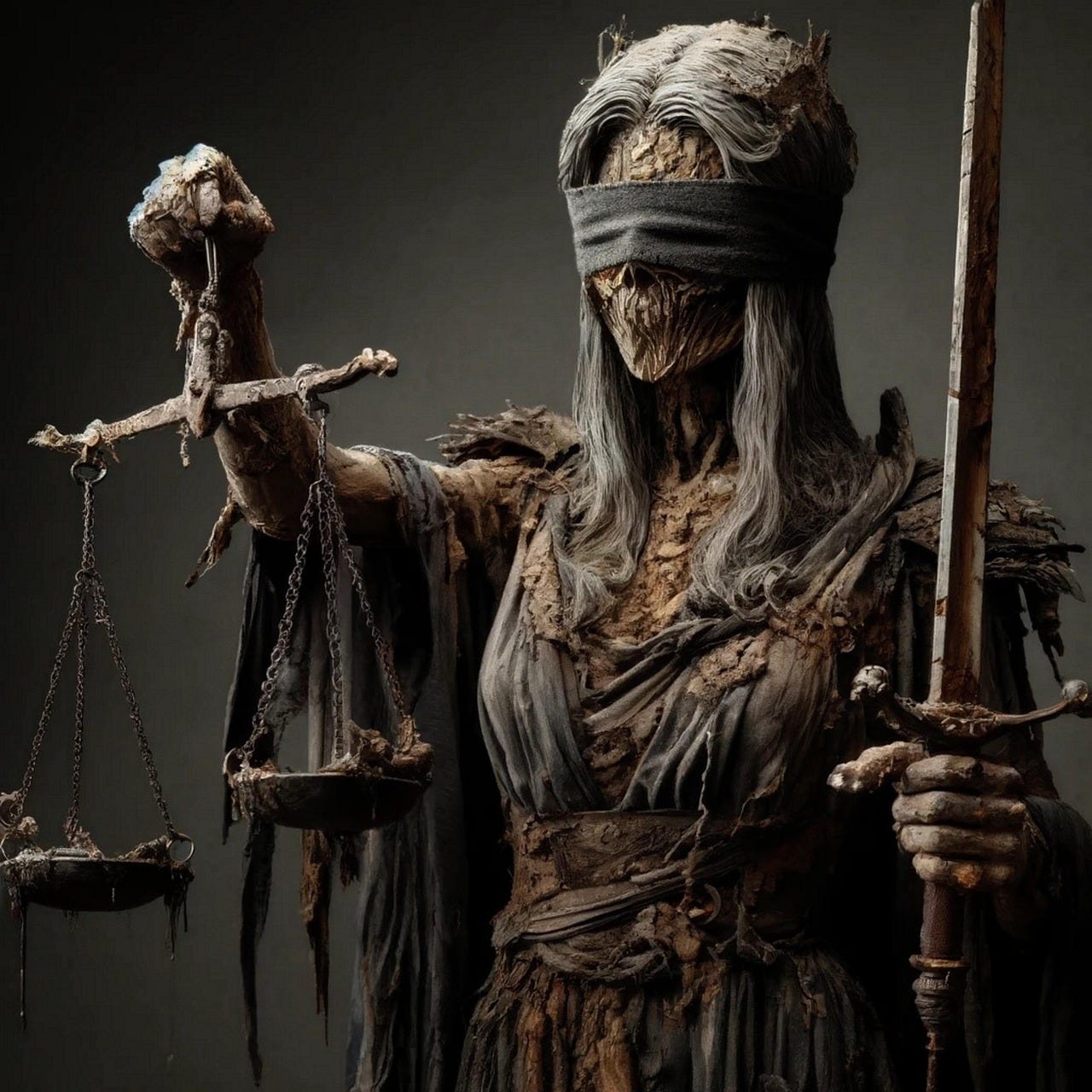
The Transparency International Corruption Perceptions Index for 2025 was just released, and progress in the fight against corruption shows to have been limited. Out of 182 countries and territories ranked by the international organization, only 31 countries have made significant progress in reducing their corruption levels since 2012.
This is unacceptable. As I wrote three years ago, corruption doesn’t just impact military budgets and capabilities, weakening nations’ defenses, but also enables authoritarianism and government aggression.
Protests are stifled via government force, free speech is suppressed, and those who speak out are arrested, or worse. Those who publicly oppose government policies lose their livelihoods and sometimes their lives.
Because media and opposition voices are strangled, corrupt government officials feel empowered to continue their violence and aggression. Messaging is one-sided, and the people are fed a steady diet of lies and propaganda. Public discontent rises, since the government shuns its mission to protect people from violence, and more and more opposing views are stifled, but a good portion of the people swallow the lies because government propaganda is the only source of information they have.
I was referring to Russia in the above, but Russia is by far not the only country that is plagued with these problems.
What does the Corruption Perceptions Index (CPI) say about 2025?
Transparency International warns that even the world’s most established democracies, such as the United States, UK, and New Zealand lack the leadership to fight corruption. Even Denmark, which was again ranked at the top, declined by one point last year.
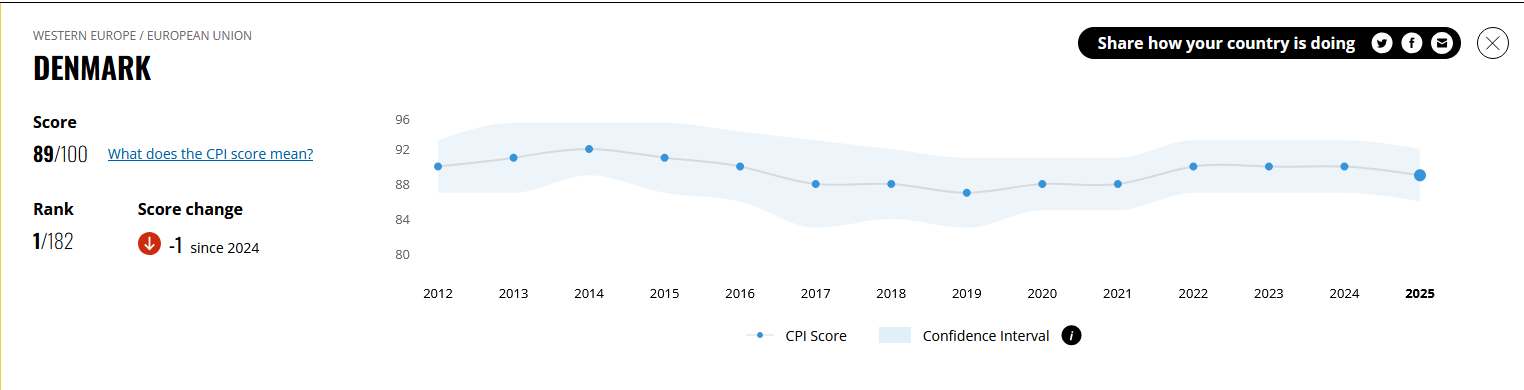
Denmark is one of only five countries to score above 80 in the CPI. Finland (88), Singapore (84), New Zealand (81), and Norway (81) are the other four. Denmark may well have declined because it has some issues tackling foreign bribery.
While successfully prosecuting two foreign bribery cases, Denmark demonstrates a languid and even dismissive approach. Not only were numerous cases terminated under the presumption that no criminal offence had been committed, but Denmark also went so far as to profess that a “comprehensive national strategy” to combat foreign bribery “may not be needed.”
Not needed? Really? That’s some complacency there!
Transparency International notes that the “absence of bold leadership is leading to weaker standards and enforcement, lowering ambition on anti-corruption efforts around the world.”
Complacency about bribery is almost certainly an indicator of weak leadership!
In addition, countries seem to be increasing restrictions on free expression, making challenging government abuses of power difficult or even dangerous for citizens, NGOs, journalists and others. A decline in transparency and accountability allows corruption to flourish, and corruption in the public sector impedes development.
More than 400 continuous days of protests in Georgia show public dismay at the Georgian Dream (more like nightmare) government, founded by corrupt, US-designated Russian puppet billionaire Bidzina Ivanishvili. The government last year passed repressive laws, meant to criminalize protest and free speech, and according to Human Rights Watch, these new measures—coupled with violent security actions and steep fines—violate Georgians’ right to peacefully protest government abuses, “making dissent increasingly risky and leaving critics vulnerable to punitive measures.” Georgia declined by three points last year.
Uruguay is another country in the three-point drop club, despite being one of the least corrupt nations in Latin America and the Caribbean. Yes, Uruguay has strict anti-bribery laws and solid enforcement, according to the Harvard International Review, and it participates in the Interamerican Convention against Corruption, the UN Convention Against Corruption, and the UN Convention Against Transnational Organized Crime. But it hangs out in a rough neighborhood, including near Brazil (look up Operation Car Wash) and Argentina, where public procurement and high-level corruption scandals continue to make the country vulnerable to violence and organized crime. Uruguay is not immune.
Namibia is another country that dropped by three points last year. The southern African country is one of the most sparsely populated countries in the world, with a population of just over three million, according to the World Bank. But Namibia is rife with systemic corruption, from its Fishrot corruption scandal that broke in 2019 to the current scandal in which 13 people and entities from the state-owned oil company, NAMCOR have been charged in connection with a corruption scandal involving over N$500 million. According to the CPI, 78 percent of people in Namibia perceived an increase in corruption during the past 12 months. Another 11 percent of public service users paid a bribe during the past 12 months.
So what about the West?
Transparency International notes that although western European nations make up nine of the top ten countries globally in the CPI, anti-corruption efforts have largely stalled in recent years, and the region’s average CPI score dropped from 66 to 64 last year.
Let’s not forget, Viktor Orban’s Hungary is part of the EU, as is Robert Fico’s Slovakia, both of whom have actively undermined transparency and accountability by attacking NGOs, attempting to weaken whistleblower protections, and impeding investigations into organized crime and bribery, while enriching themselves.
Both countries backslid by a point in 2025.
Transparency International notes that “efforts to weaken anti-corruption rules and checks and balances, along with state attacks on civil society, independent media, and whistleblowers, are undermining the quality of democracy in the region by making abuses of power harder to detect and expose.”
Leadership is needed in Europe. The UK, France, and Spain have all declined in the 2025 CPI, and although all three have been working to strengthen anti-corruption efforts, closing loopholes, and making government officials more accountable, whether these measures will be successful remains to be seen.
France doesn’t seem to be too interested in strengthening anti-corruption measures, and plans to do so have not been championed by any MPs or presented at the weekly Council of Ministers chaired by Emmanuel Macron. Several high profile corruption cases have also dragged France down the CPI.
A Senate report released in May found that the French government covered up consumer fraud by food giant Nestle, allowing the company to use prohibited treatments to produce “natural” mineral waters, including Perrier.
Ex-president Nicolas Sarkozy was imprisoned for 20 days in October after being found guilty of illegally seeking funding for his successful presidential campaign from former Libyan leader Muammar Gaddafi.
And, in an ongoing scandal, far-right leader Marine Le Pen and others from her National Rally party were found guilty in March of embezzling European Parliament funds.
The UK claims it will strengthen anti-corruption enforcement. The Government’s white paper on policing proposes establishing a National Police Service and aims to change the way serious crime, including fraud, is investigated.
Media reports indicate that sanctioned Russian oligarchs continue to hold significant assets in the UK that haven’t been frozen by sanctions. Luxury homes, apartments, and office buildings were uncovered by Transparency International last year
Among them is Witanhurst in Highgate, the second-largest house in London after Buckingham Palace. The mansion has been linked to Andrey Guryev, owner of the PhosAgro group, a Russian chemical holding company, although his representatives deny this.
The report also mentions a £90 million (US$118 million) mansion in Kensington Palace Gardens that is believed to belong to Russian billionaire Roman Abramovich. HM Land Registry lists the owner as Cyprus-based A. Corp Trustee, whose address is a building at the stadium which is home to Chelsea FC, the football club previously owned by Abramovich.
Meanwhile, sanctioned Russian oligarch Roman Abramovich, STILL hasn’t given Ukraine the proceeds of the sale of his stake in the Chelsea football team. The UK is currently issuing sternly worded threats.
Spain’s Prime Minister Pedro Sanchez recently had to publicly defend himself and his Socialist Party against accusations of corruption. Investigations are exploring whether high-ranking Socialist officials received kickbacks in exchange for awarding public works contracts, as well as allegations of corruption against Sanchez's wife and brother.
Sanchez also claimed that the government was in the process of implementing anti-corruption measures announced in July. But… The Group of States against Corruption (GRECO) last August found that Spain was a failure at complying—fully or partially—with the 19 recommendations for combating corruption GRECO presented in 2019.
To be fair, GRECO acknowledges some progress, despite the fact that even those measures have not been fully implemented.
Specifically, it establishes partial non-compliance for 16 of the 19 recommendations and total non-compliance for the remaining three. By 2023, six measures had not yet been addressed by the Spanish government.
As for the United States…
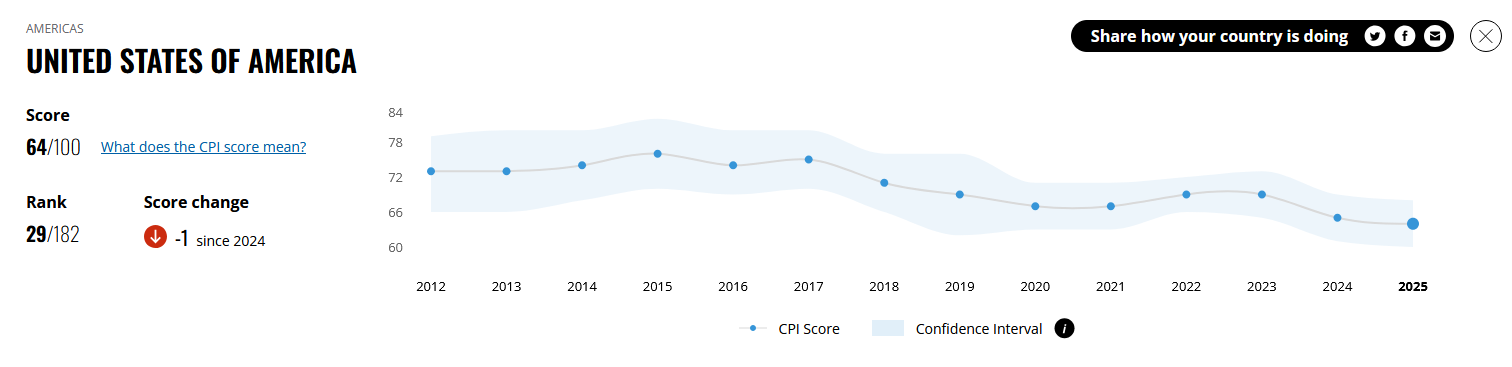
I will admit I was shocked at our one-point decline.
I thought we were going to drop more than that.
This is not because of my politics, which those who know me realize are all over the place and cannot be pigeonholed. This is because I’ve been following corruption for a long time, and I don’t like what I’m seeing.
We scored a 64 out of 100 in the current CPI, and we rank 29/182 behind countries such as the aforementioned Uruguay, the UK, and the United Arab Emirates.
Wait! We’re behind the UAE? The UAE that caters to rich, corrupt, sometimes-sanctioned Russians and kleptocrats who are anxious to move and hide their assets and evade sanctions - all in the name of “neutrality,” of course? THAT UAE?
Yes, that UAE is ranked 21/182 with a score of 69 out of 100 after having gained a point last year.
Transparency International cites issues such as targeting independent voices and undermining judicial independence, as well as limiting enforcement of the Foreign Corrupt Practices Act as raising serious concerns and dropping the US score to its lowest in history.
But there’s more.
In March, I wrote that the Treasury Department suspended enforcement of the Beneficial Ownership requirement of the Corporate Transparency Act (CTA) that would have made the use of anonymous shell companies—the ultimate tool to hide and move dirty assets, evade sanctions, and store misappropriated funds—that are used to obscure assets in 85 percent of cases analyzed by Transparency International.
In addition, the Financial Crimes Enforcement Network (FinCEN) in March issued an interim final rule removing the requirement for US companies and US persons to even report beneficial ownership information to the agency. During our 2016 Mutual Evaluation, the Financial Action Task Force (FATF)—in which the United States is a leader—noted that our “system has serious gaps that impede timely access to beneficial ownership information.” FATF in 2024 upgraded our rating on beneficial ownership transparency to “largely compliant” with FATF Recommendation 24 because of the CTA requirement to submit beneficial ownership information. Can’t wait to see what this year’s scheduled mutual evaluation brings. 🫣
Former Binance CEO Changpeng Zao (CZ), who served four months in prison after pleading guilty in 2023 to charges he enabled and encouraged money laundering and sanctions evasion during his time at the crypto exchange, was issued a pardon by Donald Trump last year. CZ claims that he has no business relationship with Trump’s family, but apparently that’s not exactly accurate.
A $2 billion investment by a state-owned firm in Abu Dhabi (yes, THAT UAE) into Binance used USD1—a stablecoin created by World Liberty Financial. Care to guess who founded and backed World Liberty Financial? Yes, the Trump family. Zhao remains a major shareholder in Binance.
The Wall Street Journal reported in October that Binance formed a high-level task force to strike a deal with World Liberty Financial that Binance could leverage into clemency for Zhao. Ahead of the launch of World Liberty’s USD1, Binance deployed a team of engineers to build the technology behind the currency.The Pentagon in May accepted a luxury Boeing 747 jetliner as a gift from Qatar and the Air Force has been asked to find a way to rapidly upgrade it for use as a new Air Force One. Qatar is obviously hoping for increased access and influence, which it has for years been working to increase.
All this, in addition to tossing Cabinet-level positions, ambassadorships, executive pardons for corrupt politicians, and dropped investigations to political allies and high-value donors.
This is just a taste.
The United States can and should be a leader in fighting corruption. It should mandate transparency and accountability. It should fight to ensure that the government is accountable to the people of the United States.
Yes, the people of the United States elected Donald Trump and this government. However, I’m pretty sure they didn’t elect someone who publicly and unconstitutionally calls for the government to take over elections in the United States, whose administration officials blatantly lie about the Epstein files and malign US citizens killed by officials as “terrorists.”
What does it tell you when an increasing number of Americans are dissatisfied with the corruption they see in the current administration?
Americans are more likely now than they were in January to say that corruption is a very serious problem among the following Republican elected officials: U.S. presidents (43% vs. 32%), members of Congress (41% vs. 32%), and Republican governors (30% vs. 23%).
What do increasing concerns among Americans about corruption and its effects to the vital interests of the United States tell you?
Three-quarters of Americans think US government corruption poses a critical threat to the vital interests of the United States in the next 10 years (73%), and an additional two-thirds express concern about weakening democracy in the United States (65%).
Some will claim these polls are biased or leftist. Maybe so.
That said, the indicators are there, and they’re worrisome.
✅ Restrictions on free expression
✅ Making challenging government abuses of power difficult or even dangerous for citizens, NGOs, journalists and others
✅ Efforts to control elections
✅ Weakening of anti-corruption enforcement measures
✅ Weakening states’ ability to regulate AI and other technologies
✅ Stifling whistleblower complaints
So yes, I’m shocked we didn’t drop even further in the CPI. I just hope we change course before we do.
The United States needs to take the reins of the anti-corruption battle and lead the world to stop malign actors.